
Last updated November 17, 2026
 Driveway & pavers
 Kitchen remodeling
 Bathroom remodeling
 Home additions & ADU
 Roofing
 Windows & doors
 Fence
Free written scope consultation - allowances, timeline, and change-order rules on paper before a single trade is scheduled
The Complete Driveway & Pavers Guide for Burbank Homeowners
Most driveway failures in Burbank start six inches underground, not on the surface. Homeowners spend weeks choosing a paver color and pattern, then let the base get rushed. Two winters later the surface is wavy, the joints are spreading, and the fix costs more than the original job. We’ve watched this happen enough times that we now treat base preparation as the entire conversation. Burbank’s clay-heavy soil, sustained San Fernando Valley heat, and neighborhood HOA rules all narrow the choices long before style enters the room. In this guide you’ll learn what actually holds up in Burbank, how the city’s permit and stormwater process works, and how to compare installers without getting talked into the wrong system.
Quick Answer
Driveway pavers in Burbank hold up when the base is engineered for expansive clay soil – typically 6 to 8 inches of compacted Class II aggregate over geotextile fabric – and when the paver type is matched to Burbank’s summer heat. Concrete pavers, travertine, and permeable systems all work here, but only with correct base depth and drainage. Permits and HOA approval usually matter more in Burbank than in surrounding cities.
Styles & brands we work with
- Kitchen remodeling
- Bathroom remodeling
- Home additions & ADU
- Roofing
- Windows & doors
- Driveway & pavers
- Fence
Table of Contents
- Why Burbank Driveways Are Different From Most California Driveways
- Burbank’s Clay Soil and Why Base Depth Comes First
- Which Paver Materials Hold Up Under Burbank Heat
- Burbank Permits and When a Repave Triggers Stormwater Review
- HOA Rules in Magnolia Park and Other Burbank Neighborhoods
- Sand-Set vs. Mortar-Set: Which One Is Easier to Repair
- How a Proper Paver Driveway Goes In, Step by Step
- What Paver Driveways Typically Cost
Why Burbank Driveways Are Different From Most California Driveways
Burbank sits in the eastern San Fernando Valley, which means long stretches of triple-digit heat in summer, a short mild winter, and soil that was laid down in a way that traps water near the surface. That combination punishes shortcuts. A driveway that survives a decade in a sandier part of Southern California can fail in three years in Burbank if the base wasn’t compacted properly.
The heat is the other half of the story. Asphalt and some low-grade concrete pavers soften and again harden across hundreds of hot days, which is why color fading and surface scuffing show up faster in Burbank than in cooler coastal cities. Light colors and higher-density pavers handle it better.
There’s a third factor that catches transplants by surprise: Burbank’s housing stock is older. Many homes in Magnolia Park, Rancho Equestrian, and the neighborhoods around Downtown Burbank were built with narrow driveways and shallow approaches to the street. That geometry limits what fits – a 20-foot-wide paver ribbon won’t work where the driveway is 9 feet. It also changes how drainage has to be handled, because the slope from garage to street is often steep and short.
What all of this means for you: on a Burbank driveway, the base system and drainage design matter more than the paver style. Pick the style you like, but pick it last, after the base plan is settled.
Burbank’s Clay Soil and Why Base Depth Comes First
Burbank’s soil is largely expansive clay, and expansive clay does one thing very well: it swells when it takes on water and shrinks when it dries. Under a driveway, that movement translates directly into the paver layer. If the base is too thin or the aggregate is wrong, the clay moves and the pavers follow. That’s why we treat base depth as the single most important decision on any paver driveway in Burbank.
What a correct base looks like
- Excavation to full depth. The installer removes enough soil that the finished paver surface lands at the correct grade. Base thickness is measured after compaction, not before.
- Geotextile fabric. A woven or non-woven separation fabric goes over the subgrade to stop fine clay particles from migrating up into the aggregate. Without it, the base loses its structure over time.
- Class II aggregate in lifts. Base material goes down in 2 to 3 inch lifts, each compacted before the next goes in. Dumping 8 inches at once and compacting the top is a shortcut that shows up as settling within two seasons.
- Plate compaction at each lift. A vibratory plate compactor, not a hand tamper, on every layer.
- Final grade check. The base should slope away from the garage and toward the street or a drainage point at roughly a 1 to 2 percent fall. Standing water is the enemy of every paver system.
- Edge restraint. A proper concrete or aluminum edge stops the pavers from spreading, which is the most common failure on older Burbank driveways.
Why 4 inches is not enough here
We sometimes hear that a 4-inch base is fine because that’s what someone’s cousin did. In sandy soil, maybe. In Burbank’s clay, 6 to 8 inches of well-compacted aggregate is the starting point we recommend for residential driveways, with the upper number for driveways that see heavy vehicles. The extra cost of base material is small compared to tearing out and redoing a failed surface.
Which Paver Materials Hold Up Under Burbank Heat
Once the base is right, the material question becomes about heat tolerance, drainage, and how the surface will look in five summers. Not every paver type that works in coastal California works the same way in Burbank, where the driveway is baked by the sun for months at a time.
Concrete pavers
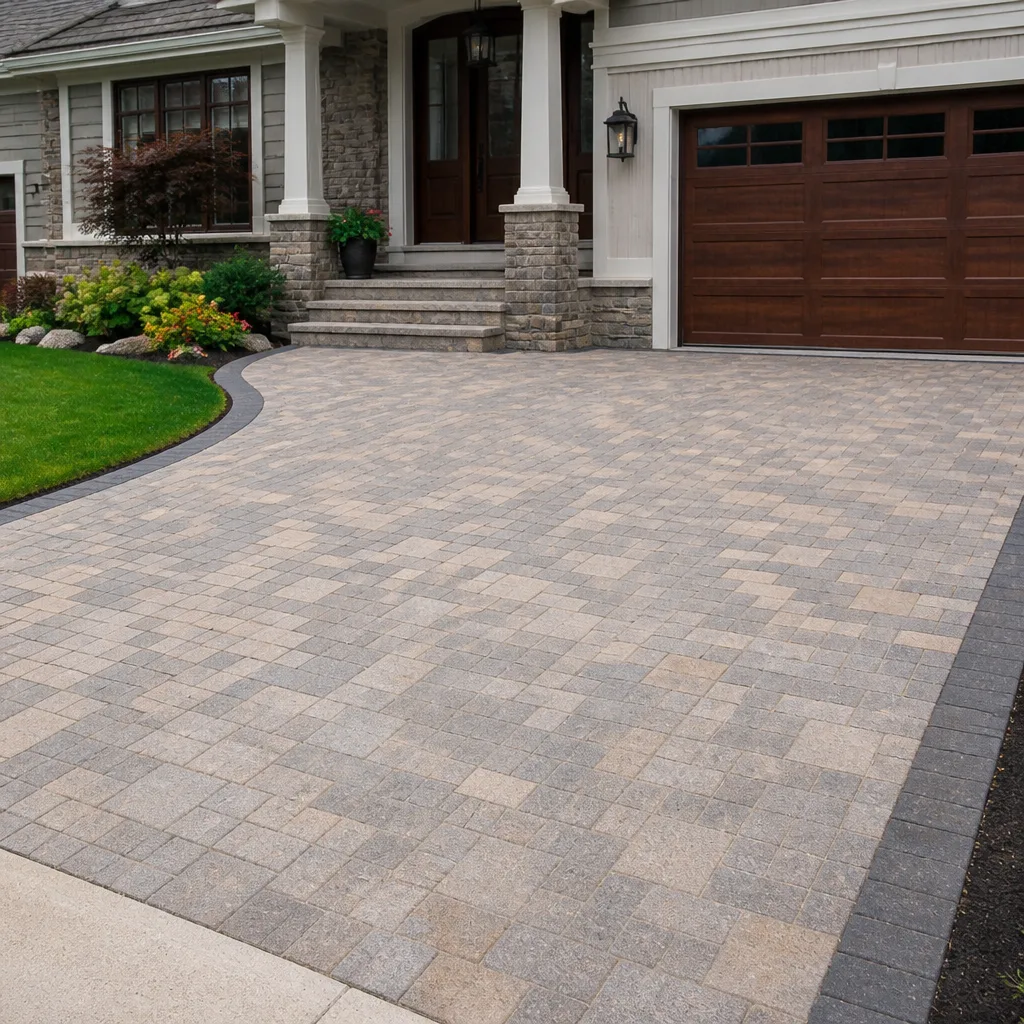
Concrete pavers are the workhorse choice for Burbank. They handle heat well, they’re available in a wide range of colors (light tones reflect heat and stay cooler underfoot), and individual units can be pulled and reset if a utility line needs access. Higher-density pavers from brands like Belgard, Techo-Bloc, and Tremron resist surface wear better than entry-level blocks. This is the material we most often recommend when a homeowner wants something durable without a big maintenance commitment.
Travertine
Travertine stays noticeably cooler underfoot than concrete or brick in Burbank’s summer heat, which makes it a popular choice for homeowners who walk barefoot from the car to the door. It’s a natural stone, so no two pieces look alike, which is either a feature or a headache depending on your taste. Travertine needs a solid base just as much as concrete pavers, and lighter-colored, tumbled varieties fade less in direct sun. It also needs a sealant refreshed periodically.
Permeable pavers
Permeable pavers – interlocking units with wider joints and an open-graded base underneath – let water drain through instead of running off to the street. In Burbank, they’re worth a look for driveways where the slope makes surface drainage difficult or where the city’s stormwater rules push toward on-site infiltration. They cost more than standard concrete pavers because the base system is more involved, and they need the voids kept clear of debris. Talk to us before committing; not every Burbank lot is a good fit.
Clay brick pavers
Clay brick is heat-tolerant and classic, but in Burbank it needs careful installation because thin, low-fired bricks can spall (flake at the surface) under repeated cycles of heat and moisture. If brick is the look you want, choose a higher-fired, thicker product and pair it with a rubber or polymeric joint sand.
Burbank Permits and When a Repave Triggers Stormwater Review
Whether your paver driveway needs a permit depends on scope. A straight replacement of the surface over an existing, unchanged driveway footprint often doesn’t – but any change to the driveway’s footprint, width, or connection to the street or sidewalk usually does. Stormwater rules also kick in when the project increases impervious surface area or changes how runoff leaves the property.
Projects that typically require a permit in Burbank
- Widening the driveway, or adding a new driveway where none existed
- Changing the curb cut or the apron connecting the driveway to the street
- Adding impervious surface area beyond what was previously on the lot
- Regrading that changes the flow of stormwater off the site
- Any paver system whose installation changes how the driveway drains
What the stormwater review looks like
Burbank’s stormwater approach, like most California cities, is built around keeping runoff from overloading the storm drain system and local creeks. When a project adds impervious area, the city may ask how that runoff is being handled – through grading, a swale, permeable pavers, a dry well, or another method. What the city specifically requires varies with the project, so the honest answer is: confirm with the Burbank Community Development Department before the design is locked in. We pull the permits as part of the project and make sure the driveway is built to the approved plan. If the plan requires a specific drainage approach, we build to it, not around it.
One more Burbank-specific note: many older driveways sit on lots that were graded before current drainage thinking, so the “existing conditions” a homeowner assumes are fine can turn out not to be. A quick conversation with the city early saves a redesign later.
HOA Rules in Magnolia Park and Other Burbank Neighborhoods
Burbank has an active HOA landscape, especially in Magnolia Park and the pockets of attached homes and planned communities scattered through the city. If your property is governed by an HOA, the material and color conversation starts with the HOA’s design guidelines, not with a catalog.
What Burbank HOAs commonly regulate
- Color palette. Many require earth tones, warm grays, or specific shades that blend with surrounding homes. Bright reds and pure whites are often restricted.
- Paver pattern. Herringbone, running bond, and ashlar patterns are usually acceptable, but some HOAs specify one.
- Material type. Some allow only concrete pavers; a few disallow travertine. Permeable systems are usually welcomed but sometimes need approval.
- Finished height and slope. HOAs care about how visible the driveway is from the street, so grade changes may need sign-off.
- Drainage. Any visible drain channel, trench, or swale may need design review.
What an HOA submittal typically includes
- A materials specification sheet from the paver manufacturer
- Color and pattern samples, sometimes physical samples
- A site plan showing the driveway footprint and drainage direction
- Photos or renderings of the finished look (some HOAs require this)
- A construction timeline
We ask for the HOA’s design guidelines at the first estimate visit, so the material selection we recommend can clear the submittal the first time. Resubmittals are not just an administrative nuisance; they add weeks to the front end of a project.
Sand-Set vs. Mortar-Set: Which One Is Easier to Repair
The joint system – sand-set or mortar-set – decides how easy the driveway will be to repair years down the line. In Burbank’s clay soil, something will eventually need repairing, whether it’s a settled paver, a lifted section, or a utility break. The joint system determines whether that repair is a small afternoon job or a full section replacement.
Sand-set
Sand-set pavers sit on a thin sand layer over the compacted base, with sand swept into the joints (or, better, polymeric joint sand that hardens slightly and resists erosion). Individual pavers can be lifted with a small hand tool, the base recompacted, and the pavers reset. Sand-set is the standard driveway system in Burbank and is the system we most often recommend, precisely because repairs are straightforward.
Mortar-set
Mortar-set pavers are bonded to a concrete slab with a thin mortar layer, and the joints are grouted. The result is a more rigid surface and a very clean look. It’s common on walkways and patios, less common on driveways. The downside is repair: any failure, whether from a base issue, tree roots, or a utility line, requires breaking out the affected pavers and often a section of the slab. Five years out, if something moves, sand-set is the system you’ll be grateful you chose.
Which we recommend for Burbank driveways
For the vast majority of Burbank driveways, we recommend sand-set with polymeric joint sand over a properly compacted base. Mortar-set can work for decorative aprons or short runs, but for a full driveway in clay soil, the repairability advantage of sand-set is hard to match.
How a Proper Paver Driveway Goes In, Step by Step
Every reputable installer’s process will look close to this. If a quote skips steps or compresses the timeline, ask why.
- Site walk and measurement. Confirm the footprint, slopes, drainage direction, and any HOA or city constraints.
- Utility check. Confirm the location of gas, water, sewer, and electrical lines before any excavation.
- Demolition and haul-away. Remove old concrete, asphalt, or pavers and haul off the debris.
- Excavation. Dig to the correct depth for the finished paver and base system.
- Subgrade preparation. Level and compact the exposed subgrade, correcting soft spots or areas that hold water.
- Geotextile placement. Install separation fabric over the subgrade.
- Base install in lifts. Add Class II aggregate in 2 to 3 inch lifts with compaction between each.
- Final grade and edge restraint. Verify slope, install edge restraint, and bed the setting layer.
- Paver install. Lay pavers in the approved pattern, cutting edges to fit cleanly.
- Joint sand and compaction. Sweep polymeric joint sand into the joints, compact, and clean.
- Final walkthrough. Confirm drainage, finished grade, and that the site is clean.
A typical Burbank driveway project runs a handful of days for the construction itself, with the front-end design, permitting, and HOA approvals adding time before work starts. If a contractor promises a full driveway in one day, they’re skipping lifts and compaction – which is the shortfall you’ll pay to fix twice.
What Paver Driveways Typically Cost
Paver driveways are priced per square foot, but the differences between quotes come down to base system, edge restraint, and drainage details. A cheap square-foot number usually means less base and thinner edge restraint – which is exactly what fails in Burbank’s clay.
In our experience, homeowners see ranges roughly like this for residential paver driveways in the Burbank area. Every quote we write is a line-item written estimate, so you can see exactly what’s included and what isn’t.
- Concrete pavers: typical range roughly $12 to $22 per square foot installed, with base, setting layer, edge restraint, and joint sand included
- Travertine: typical range roughly $18 to $30 per square foot installed
- Permeable paver systems: typical range roughly $18 to $28 per square foot installed, including open-graded base
- Clay brick pavers: typical range roughly $15 to $25 per square foot installed
- Removal and haul-away of existing surface: additional cost, varies by thickness and access
- Drainage additions (channel drain, dry well, swale): additional cost, quoted as a line item
These are estimates only – the written estimate we produce for your specific driveway sets the final price. We don’t change orders mid-project once the estimate is signed; if something unexpected gets uncovered during excavation, we stop and talk to you before doing anything that would change the number.
Paver brands we work with include Belgard, Techo-Bloc, Unilock, Tremron, and Cambridge Pavers, which gives us real range across price and finish. We help you choose the right material, not just any material. And because our scope includes fence installation and home additions & ADU projects, we can sequence a driveway repave around a bigger project rather than having it torn up twice. For details on service options, see our driveway & pavers page.
Common Mistakes to Avoid
- Skipping the geotextile fabric. In Burbank’s clay soil, fine particles migrate up into the base aggregate over time, robbing it of structure. Fabric is a small line item that prevents a big problem.
- Accepting a 4-inch base. Four inches of compacted aggregate is not enough over expansive clay. Ask every installer what base depth they’re planning and why.
- Choosing pattern before drainage. Drainage dictates layout, slope, and placement of any channel drain or dry well. Pick the drainage plan first, then the pattern.
- Skipping HOA pre-approval. If your Magnolia Park HOA or another Burbank HOA restricts color or pattern, installing first and asking later can mean a tear-out.
- Assuming a repave needs no permit. Widening the driveway, changing the curb cut, or adding impervious area typically does trigger a permit and possibly stormwater review.
- Going mortar-set on a full driveway. Mortar-set looks great on a walkway. On a driveway in clay soil, it’s much harder to repair if something shifts.
- Picking a very dark paver in full sun. Dark surfaces get very hot in Burbank’s summer sun, which fades color faster and can be unpleasant to walk on barefoot.
See the difference
 Before
 After
 Before
 After
 Before
 After
When to Call a Professional
Some driveway issues are cosmetic and can wait. Others are signs that the base under the pavers has moved, and those tend to get worse, not better. Call a professional if you’re seeing pavers that are wavy or dipping in a single area, joints that keep opening after you refill them, standing water after rain, or a paver surface that’s separated from the edge restraint. Any of those points to a base or drainage problem that no amount of joint sand will fix. If your driveway was installed over clay without proper base depth, the sooner it’s diagnosed, the smaller the repair. Construction Burbank offers free estimates in Burbank – call (833) 954-6131. We answer 24/7, with fast dispatch from 7am to 7pm, Sunday through Friday.
Frequently Asked Questions
We recommend 6 to 8 inches of compacted Class II aggregate over geotextile fabric for most residential driveways in Burbank, with the upper end for driveways seeing heavier vehicles. Burbank’s expansive clay soil moves seasonally, and a thicker, well-compacted base is what keeps that movement from telegraphing into the paver layer. Anything under 6 inches is a design choice you’ll likely revisit. Call (833) 954-6131 for an exact quote – estimates are free.
A straight surface replacement over the same footprint often doesn’t require a permit, but any change to the driveway’s width, footprint, curb cut, or impervious area usually does, and can trigger Burbank’s stormwater review. The safest move is to confirm scope with the Burbank Community Development Department before finalizing the design. We pull the permits as part of the project and inspect as required. Call (833) 954-6131 to talk through your specific scope.
Concrete pavers and travertine are the two materials we most often recommend for Burbank driveways. Concrete pavers in light tones reflect heat and hold up well over cycling temperatures, and higher-density products from Belgard, Techo-Bloc, or Tremron resist surface wear better than entry-level pavers. Travertine stays cooler underfoot, but needs a sealant refreshed periodically. Call (833) 954-6131 for an exact quote on your driveway size and material choice.
Both can last decades when the base is right, but sand-set is far easier to repair in Burbank because individual pavers can be lifted and reset without breaking out a slab. In clay soil, something eventually needs adjusting – a settled paver, a shifted section, a utility break. Sand-set keeps that repair small. Call (833) 954-6131 and we’ll walk you through the difference for your specific driveway.
Ask your HOA for its current design guidelines before selecting a paver, then bring those guidelines to your first contractor visit. Most Burbank HOAs want a materials sheet, a pattern sample, a site plan, and a construction timeline as part of the submittal. We help homeowners prepare that submittal so it clears the first pass. Call (833) 954-6131 to set up a free estimate and we’ll review the HOA requirements with you.
The written estimate we produce sets the price for the scope of work described. If excavation uncovers something unexpected – a broken utility line, an old slab under the existing surface, or a soft spot in the subgrade – we stop and talk to you before doing anything that would change the number. We don’t issue surprise change orders mid-project. Call (833) 954-6131 for a free line-item estimate in Burbank.
The Bottom Line
A paver driveway in Burbank succeeds or fails on the part you can’t see. Get the base depth right for the clay soil, use geotextile fabric, compact in lifts, and choose a sand-set joint system that’s easy to repair. Then pick the material – concrete pavers for durability, travertine for cool underfoot, permeable pavers if Burbank’s stormwater rules push you that way. Check HOA guidelines before ordering, confirm the permit scope with the city, and compare quotes on base system as much as on square-foot price. That’s the sequence that gets you a driveway still looking right a decade from now. Construction Burbank handles the whole thing under one contractor, from base engineering to the final joint sand, and from the driveway’s edge to the roofline if you have other work to bundle. Call (833) 954-6131 for a free estimate. We answer 24/7. Fast dispatch from 7am to 7pm, Sunday through Friday. You can also start by visiting our Construction Burbank page for the full scope of what we do.
Written by the team at Construction Burbank.